ADJUST THE THERMOSTAT, OR STEADY ON?

Heat being heat. [PD] Wikimedia

Heat being heat. [PD] Wikimedia

Of course it’s not that simple. It’s all about mass. And the mass of one house can be arranged quite differently from the next. It’s particularly the hot mass you need to keep in mind.

The Umpteenth Law of Thermodynamics says every speck of matter  in the universe is trying to arrive at the same uniform temperature. Hot things are forever shedding heat, and cold things are forever absorbing it. We try to arrange our homes in a way that prevents heat from radiating out into the cold air, snow, trees, cars, and the black universe. But heat escapes nonetheless.

And the warmer your house is, the faster heat will pulse outside to achieve harmony with coldness. That’s why it saves energy to turn the thermostat down when you’re sleeping or working: The closer the inside temperature is to the outside temperature, the less ambitious the heat is about cooling off.

The big, fat caveat, especially here in Maine where many old houses still hiss and thump along with steam heat, is that mass messes up the thermodynamics (which weren’t particularly tidy to begin with). Steam has to heat up hundreds of pounds of cold, iron radiator before much heat can pass into the air and the walls and the toilet seat. Same goes for radiant heat in concrete floors: The heating mass takes a long time to cool off; then a long time to heat up.

Even so, turning the thermostat up and down for an old steam system doesn’t make the furnace work any “harder,” or burn more fuel in the long haul. It truly does save energy (money), says the Department of Energy–about 1% savings per degree if you turn down for eight hours a day.

The problem is that you may not love the sluggish changes in temperature that result from a massive heating system: By the time the bathroom gets warm in the morning, it’s time to go to work.

The cool news is that new thermostats are much better at physics than I am. Brainy new appliances can continuously calculate the ideal timing of your furnace’s bursts of effort.


 

50 SHADES OF FHA

B&D, FHA style. wikimedia commons pd

B&D, FHA style. wikimedia commons pd

Numbers are the least sexy part of real estate. But let me see what I can do here to pump up the excitement: $98 a month, that’s what Obama’s new mortgage change will mean to the average Portland home-buyer who’s hot for an FHA loan.

FHA loans do help people of limited means slip into comfortable homes. But these loans tend to be turgid with fees. Among the most rapacious of these is the “mortgage insurance premium.” Right now, that fee engorges the purchase cost of your house by 1.35%.

This may not sound like a huge hunk, but whip out your calculator. Actually, let’s ask my smokin’ hot pal Laura D’Andrea (laura@lendersnetwork.biz) to whip out her calculator: She’s a Portland mortgage originator, and would be the first to assure you that size does matter. Taking an average Portland home, here’s the impact of the sleeker, stripped-down mortgage insurance premium (MIP). For a $245,000 house:

With the minimum 3.5% down payment, under the current MIP rate, you’ll pay about $266 each month just for the MIP. But for that same loan approved after January 26, the MIP payment will be $98 less. Over the life of a 30-year loan, that’s $35,280 in your pocket.

That’s $35,280 you could spend buying the house you’re passionate about vs. the house your mother would choose for you.

Now, two things about the MIP still rub me the wrong way. With “conventional” loans, you can slip the sweaty grip of MIP once you’ve paid for 20% of the home. After all, the whole point of mortgage insurance is to make sure the lender can recover its money if you pull a one night stand–and if the home is worth 20% more than the loan balance, the lender should be safe.LD

But FHA plays rough. It’s going to squeeze you tight for the entire life of the loan. So go ahead and take a tumble with this enticing new MIP. But keep that safe word on the tip of your tongue: Refinance!

WHAT THE HECK IS A ZILLOW?

[PD] wikimedia

[PD] wikimedia

What is Zillow, exactly, and… why?

Well, back in the day, all real estate agents worked for sellers. In Maine, anyway, the seller’s agent collected a commission from the seller, then either found a buyer herself, or paid part of the commission to any “sub-agent” who could rope in a buyer. Maine, anyway, now does a good job of giving buyers a chance to retain their own advocate.

But a hangover furrows the brow of the industry still.

For one thing, the seller’s agent still usually collects the entire commission, out of long habit. The buyer’s agent is still typically paid by the seller’s agent, in Maine. Just out of habit. It works; it’s just peculiar.

And then there’s a headache known as Zillow. (And Trulia, etc.) Now that buyers are choosing agents of their own, those buyers have become a valuable commodity. Everybody and his uncle is trying to catch them, and then sell them to real estate agents.

And that’s what Zillow does. Now that buyers are free to take their own path to a house for sale, Zillow has done a particularly good job of making the path wide and easy to navigate on a smart phone. Zillow sells advertising space to real estate agents who want their smiling face to pop up beside your search results.

So that’s a Zillow: It collects house-hunters and sells them to agents.

Real estate agents resent the Zillows of the world for various reasons. Old-school agents see Zillow as a poacher, stealing buyers who used to be forced to deal directly with the seller’s agent.

Busy agents resent Zillow for telling their buyer clients that 234 School Street is available, when it is long gone. Zillow’s data is famously dirty, which wastes everybody’s time.

Me? I think the customer is always right: Home hunters want decent searching tools. Zillow solved a problem, and if it’s not yet perfect, it’s pretty good.

And now, to recapture those free-range buyers, agents are getting creative.

Some are now getting their own apps. (Scan the QRC below to test-drive my very own, built by Keller Williams. I’d love to hear reviews. It’s easy to delete if you don’t like it.)

Agents are also exploring the value of their proprietary data banks which, after all, are built, maintained, and updated at agents’ expense. Broker organizations are demanding that Zillow direct some of those free-range buyers back toward the listing agent in exchange for data.

But to my mind, the whole kerfuffle overlooks the goal of the seller: to present her house to as many people as possible. If Zillow can bring my client’s house to your attention, I don’t care what agent brings you to the door.

Next time: Redfin

Hannah Holmes Keller Williams smart-phone realty search thingamajig

Hannah Holmes Keller Williams smart-phone realty search thingamajig

EIFS AND THE TARGETIZATION OF PORTLAND

image

Image: CBT Architects

The technical name for the stuff is EIFS–Exterior Insulation Finishing Systems. The reality of EIFS: Styrofoam stucco. The problem: This exterior finish wants in.

I’m not presuming that the Miami developer behind the huge-ish housing complex proposed for Portland’s Bayside is committed to cladding that conglomeration with EIFS. I’m just saying that this rendering looks quite a lot like the finish you’ll find gracing the exterior of your local Target store.

Above is one of the four buildings now proposed for the strip along Somerset Street behind Trader Joe’s and the former DHS building. This thing will face a dignified, old, brick-clad building across Somerset. 

Screenshot (42)

Right: Monotonous facade offering “unvaried pedestrian experience.” Speaking as a pedestrian and a hater of change, I like it just fine. Left: TBD. Image: Google Maps

I’m delighted to read in The Press Herald that Portland Planning is leery of both EIFS and vinyl siding for this colossal project. That’s major.

I am, however, alarmed that some feel the proposed facades are “monotonous,” and insufficiently varied in terms of materials.

image

Image: CBT Architects

IMHO, they are not nearly monotonous enough, and the variation embodied in those scuba-mask projections and the random green squares combines the worst of the 1960’s and today’s tarpaper-townhouse aesthetics. Taken as a whole, the design reminds me of the Holiday Inn on Spring Street, which reminds me of a neglected beach in Florida.

While I’m kvetching, may I note that those roofs look suspiciously similar to parking lots, and not much like green roofs or solar arrays?

Now, to stop kvetching: I get that Portland housing costs are way too high for normal people. And that bricks are expensive. And that StyroStucco is cheap. And that vinyl is final. I get that. I vowed to tear the vinyl off my 1918 bungalow the day I bought it. Instead, I put on an addition with more vinyl. Some day, I’ll get around to adding plastic shutters, which will vary the materials and the pedestrian experience, and make the addition look less like an angular, white tumor.

Human shelter is an exercise in compromise. Its first job is to keep humans warm and dry. Its second is to ruin the planet as little as possible. The rest is up for debate.


ICE DAMS AND HOW TO NOT GET THEM

Figure-1

Image: UMN Extension

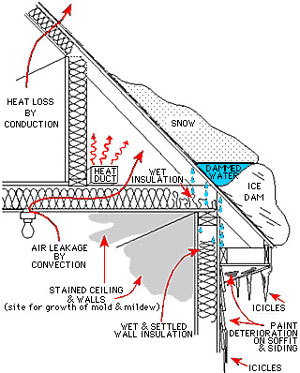
Looks like its time to re-post this: Last year, half the houses in the neighborhood developed ice dams. Part of the reason? This neighborhood has tons of bungalows.

The bungalow is native to sunny India, where the deep overhang of the eave acts like an awning.

Maine and India have little in common beyond the bungalow. Here, that overhang gets very cold, because it’s not heated by warm air rushing upward through the ceiling and into the attic.

That fleeing warm air does heat the roof over the attic, however, and melts the snow thereon. Water runs down the roof as god intended. But then it hits the unheated overhang and promptly freezes. Over time, a ridge of ice forms atop the eave. Now running water backs up behind a growing ridge of ice, seeps between the shingles, and enters parts of your house previously reserved for dryness.

The slanted ceiling of a bungalow’s second floor makes matters worse: You can’t add much insulation there to slow the flow of heat.

The outdoor angles compound the problem, as intersecting roof lines direct a lot of water toward the valleys.

What to do? Don’t do this: In a fit of freezing pique I once took a pickax to my ice dams. It tore that ice right up! And the roof under it, too!

Prevention, as usual, is the sensible thing. Maintain a clear path for water to take off the roof. Rake snow off the eaves before the cycle sets in.

And if you must build a bungalow in Maine, insulate the heck out of it.

BOX: TOPS? OR MAKE IT STOP!

box tops architecture

Photo: The Neighborhood Developers

So this pile of boxes won a big prize. Well, this and a few other components in the redevelopment of the old Box District in Chelsea, Mass. Together they won the Jack Kemp Award for Excellence in Affordable Housing. Yay. Nothing wrong with that.

But how do we feel about the way this looks?

Architecture is doing this now–boxes. All over Munjoy Hill, and now in the West End.

Of course, nothing in the world makes more sense than a flat roof–if it’s covered with plants and/or solar panels. On the other hand, New England’s history is one long tale of pitched roofs. On occasion, an Italianate bay window elbowed its between the typically flat and somber facades. Clapboard, shingle, and brick were the only sidings a respectable Pilgrim would consider.

Change happens, however. This award-winning development is platinum LEED certified, efficient, and even located on a mass-transit line, which is fantastic. The larger project revitalized what was formerly the neglected grave of a cardboard box factory. Yay.

Glickman%20Library[1]

Photo: USM

I’m just not sure I understand what this design is talking about. What is it saying to the buildings around it, to the ground beneath it, to the climate overhead? Housing design, like clothing and hair styles, is subject to fads. Some styles age better than others. How will the Box Era be judged in the coming decades?

In defense of the Box, I felt certain when the USM library got its

Photo: 118 on Munjoy Hill

Photo: 118 on Munjoy Hill

makeover that God would smite it from the face of the earth, and that has not happened. Has it aged well? I don’t know. Maybe it’s acquired the sort of patina a cardboard box gets after a winter outdoors.

But this Munjoy Hill design, in a neighborhood of restrained and Pilgrimmy buildings: In 20 years, will this blend in? Or will anyone care?