WHICH REMODELING PROJECTS WASTE THE LEAST MONEY? 

[pd] wikimedia

[pd] wikimedia

The annual home improvement survey is out, and once again the steel door tops the list of home improvements that will lose you the least money when you sell.

Clients often ask me if they should remodel the bathroom or replace the counter tops when they prepare their house to sell. They ask other agents that, too. Which is why the National Association of Realtors publishes an annual study of which home improvements buyers will pay extra for.

Yeah, none. Realtors across the country chime in, and they/we are pretty clear on this: None.

Even the steel entry door is a disappointment, with brokers estimating that buyers will pay $1,122 for your new $1162 door. Fiberglass door? Forget it. The “R” on that “I” is only 71%.

A kitchen remodel, which runs $20,000 to $50,000, nets only about 75% of your cost–at the high end! The cheaper your remodel, the smaller fraction you’ll recoup.

Most of the least-losing improvements are external: Fresh siding, garage doors, and the dearly loved steel entry door are up there. In New England, the door and even a new deck break into positive payback territory! Add two! Surround your house with decks, and make millions!

Additions–family rooms, sun rooms, and garages–are the biggest money dumps. Home office remodels are for chumps. New roofs are a ghastly miscalculation.

Here’s the thing: First impressions matter tremendously–as they should when you’re purchasing a giant consumer product with 1,000 hidden pieces that might or might not make your next 20 years a long, slow dance of regret. …Right?

So yes, no new windows. But wash the heck out of whatever windows you have. No new kitchen, but paint elderly cabinets white. If you add a sunroom ($76,000) plan on half your ROI coming back as pure joy, because it’s not going to come back as money.

If you must, if you really must, you can replace the entry door.

Check out the full list of survey items here.
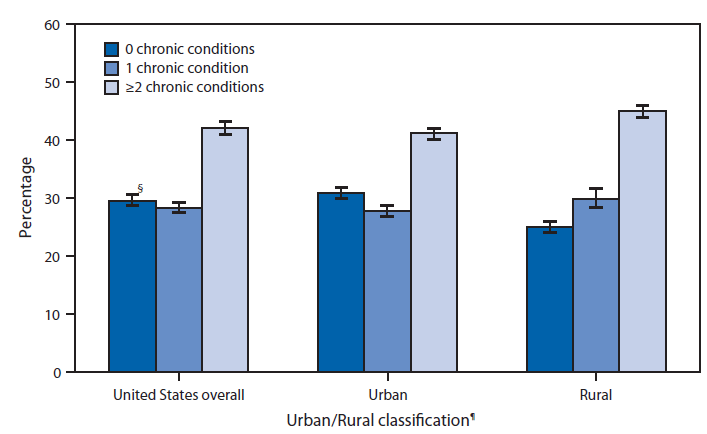


COUNTRY BUMPKIN, CITY SLICKER: WHICH IS SICKER?

City Slickers not sicker than Country Bumpkins? Image: CDC

City Slickers not sicker than Country Bumpkins? Image: CDC

When did life in the country become so bad for you? A recent study by the CDC found that rural dwellers are more likely to have a chronic and serious health condition than are city folk.

That’s crazy! Remember when cities were cauldrons of smog, and doctors prescribed a trip to the country to clear the lungs? OK, neither do I. But I’ve read that such things happened.

The CDC’s 2103 health survey of people 45 and older found otherwise. Or at least it found that something worse than diesel bus fumes is hitting country dwellers where they live. The diseases in question: hypertension, coronary heart disease, stroke, diabetes, cancer, arthritis, hepatitis, chronic obstructive pulmonary disease (COPD), weak or failing kidneys during the past 12 months, currently having asthma.

Here’s the great news, though: Rural living really isn’t that much worse than urban living.

Here’s the horrible news: Only 28% of Americans 45 or older, city and country combined, was free of all ten conditions! Forty-two percent of Americans had two! 

Wait. I just noticed arthritis in there. Seriously? Now I feel this is way less alarming. Now I’m surprised that 28% of Americans older than 45 don’t have arthritis.

Anyway, I bet if you mapped income or education across the same area, you’d find a powerful hint: Where you live isn’t as important as how you live.

MARCO POLO, SHEEP, AND SURVIVING WINTER IN MONGOLIA

Kublai Khan. Wikimedia pd

Kublai Khan. Wikimedia pd

I’ve been watching the Marco Polo series on Netflix not for the melodrama and frontal nudity, but for the real estate considerations. Primarily, how did Kublai Khan not freeze his funny little hairdo off? How warm can you really make a ger?

Pretty warm, apparently. Thanks to sheep.

The Mongolian ger, aka yurt, is a lightly-woven basket, covered with layers of felted wool. The ger is modular from the get-go, as befits a culture of sheep-followers. Accordingly, the insulation also is easily adjusted. The basic unit of insulation is a flexible version of foam insulation board, known as felted wool. The raw material is mined from a sheep, then whacked into dense sheets about an inch thick. This oily product is water and wind-repellent, and has an R-value of a bit under 1. In the winter, you pile on as many as you want. Three inches of felt mat provide an R value similar to your double-pane window (2). The old balloon-construction houses of Maine only managed R-4 or -5.

But insulation is only part of the story. Materials also lose heat through radiation. Glass is a fantastic radiator, shedding your household heat out into the winter air. Felt, according to research by a bunch of sheep, yak, camels, llamas, and goats, is not.

And air infiltration is important as well: That old Maine house has sprung so many leaks since it was built that you may as well just leave a door open all winter. The circular, even spherical, shape of the ger sheds cold wind instead of fighting it; and apparently the oily felt itself is remarkably windproof. (Modern gers have a canvas cover that helps, too.)

So Khan & Co. weren’t exactly roughing it on the Mongolian grasslands. Plus, if Netflix’s account is to be believed, no Mongolian ever spent a night alone.

BARGAIN ALERT: APPLIANCE AUCTIONS!

To be sold online. Gediman's Appliance in Bath. Photo: Keenan Auction

To be sold online. Gediman’s Appliance in Bath. Photo: Keenan Auction

You like? You go online and bid. This pretty thing is part of the Gediman’s Appliance liquidation auction in Bath and Lewiston, but a couple other auctions are coming up, as well.

The Gediman’s auction starts online January 16, and will close at 1 pm February 2. There’s a “preview,” or actually a “last-chance view,” January 30. Winners will have to unhook their winnings and haul them away on 3 February.

Included: All manner of floor-model appliances and hoods; from Viking, Bosch, Jenn-Air, Thermador, etc. www.keenanauction.com, under “Equipment Sales.”

Restaurant Thing. photo Keenan Auction

Restaurant Thing. Photo Keenan Auction

The Dunstan School Restaurant auction is live and in person, January 14 at 10 am; preview at 8. In addition to a billion coffee mugs and chairs, this Scarborough auction features industrial-size mixers, grinders, shredders, coolers, heaters, hashers, smashers, dicers and whatever this is:

However, Geek Realtor predicts the true bargains, the rock-bottom deals, the almost-free stuff, will come from an online auction of appliances, furniture, electronics, salon equipment, “fire proof wastebaskets,” and even a John Deere tractor currently residing in Vassalboro. Bidding starts January 3; last-chance in-person preview January 16; closing January 19. Whence Geek Realtor’s confidence that this will be the least-contested stuff of the lot?

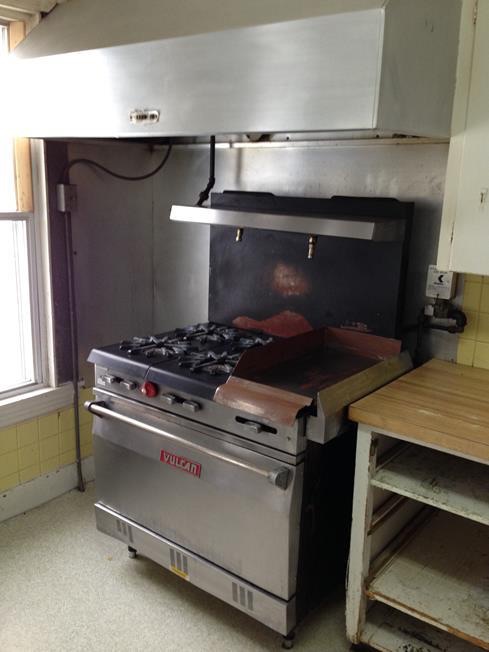
Vassalboro Vulcan (with cooties). Photo Keenan Auction

Vassalboro Vulcan (with cooties). Photo Keenan Auction

It’s a nursing home. Humans are hard-wired to avoid sick humans, and this vague sense of skeeziness applies to items worn or used by sick humans as well. Take advantage of it! The cooties wash right off.

THE WEATHER ACCORDING TO WOOLLY BEARS

Pyrrharctia isabella: Wikimedia

Pyrrharctia isabella: Wikimedia

Woolly bear says: Oil prices are down. Fill the oil tank now.

The Farmer’s Almanac predicts a cold and snowy winter for New England. The National Weather Service predicts a “normal” one. What say you, woolly bears?

Folklore holds that the length of this cute caterpillar’s black and brown segments hint at the coming winter’s length. I can never remember which part–the black ends or the brown middle–means what. Fortunately, the National Oceanographic and Atmospheric Administration has given some time to the subject.

Says NOAA, “The longer the woolly bear’s black bands, the longer, colder, snowier, and more severe the winter will be.” Dear NOAA, what could possibly be “more severe” than long, cold, and snowy? Is there a dimension of unpleasantness I’m forgetting? Frosty-bity? Wind-burny? Icerageous?

Pyrrharctia_isabella

Grown up Pyrrharctia_isabella. Wikimedia {pd]

Anyway, here’s the true fact: As a woolly bear spends the summer and fall gnawing on your dandelions and clover, it grows, and molts six times. Each time, the new skin has a wider strip of red hairs. Ergo, a woolly bear with long black ends predicts that you’re talking to a kid; a completely red one predicts that you’re looking at a ‘pillar poised on the precipice of pupation.

This puts the woolly bear’s predictive power on a par with that of the Farmer’s Almanac. Also like the Almanac, a woolly bear can survive freezing at -90F. Woolly bear don’t care how long winter is.

WHAT THE HECK IS A ZILLOW?

[PD] wikimedia

[PD] wikimedia

What is Zillow, exactly, and… why?

Well, back in the day, all real estate agents worked for sellers. In Maine, anyway, the seller’s agent collected a commission from the seller, then either found a buyer herself, or paid part of the commission to any “sub-agent” who could rope in a buyer. Maine, anyway, now does a good job of giving buyers a chance to retain their own advocate.

But a hangover furrows the brow of the industry still.

For one thing, the seller’s agent still usually collects the entire commission, out of long habit. The buyer’s agent is still typically paid by the seller’s agent, in Maine. Just out of habit. It works; it’s just peculiar.

And then there’s a headache known as Zillow. (And Trulia, etc.) Now that buyers are choosing agents of their own, those buyers have become a valuable commodity. Everybody and his uncle is trying to catch them, and then sell them to real estate agents.

And that’s what Zillow does. Now that buyers are free to take their own path to a house for sale, Zillow has done a particularly good job of making the path wide and easy to navigate on a smart phone. Zillow sells advertising space to real estate agents who want their smiling face to pop up beside your search results.

So that’s a Zillow: It collects house-hunters and sells them to agents.

Real estate agents resent the Zillows of the world for various reasons. Old-school agents see Zillow as a poacher, stealing buyers who used to be forced to deal directly with the seller’s agent.

Busy agents resent Zillow for telling their buyer clients that 234 School Street is available, when it is long gone. Zillow’s data is famously dirty, which wastes everybody’s time.

Me? I think the customer is always right: Home hunters want decent searching tools. Zillow solved a problem, and if it’s not yet perfect, it’s pretty good.

And now, to recapture those free-range buyers, agents are getting creative.

Some are now getting their own apps. (Scan the QRC below to test-drive my very own, built by Keller Williams. I’d love to hear reviews. It’s easy to delete if you don’t like it.)

Agents are also exploring the value of their proprietary data banks which, after all, are built, maintained, and updated at agents’ expense. Broker organizations are demanding that Zillow direct some of those free-range buyers back toward the listing agent in exchange for data.

But to my mind, the whole kerfuffle overlooks the goal of the seller: to present her house to as many people as possible. If Zillow can bring my client’s house to your attention, I don’t care what agent brings you to the door.

Next time: Redfin

Hannah Holmes Keller Williams smart-phone realty search thingamajig

Hannah Holmes Keller Williams smart-phone realty search thingamajig

MISTLETOE: YOU’RE DOING IT WRONG

[PD] wikimedia

[PD] wikimedia

It’s meant, according to my favorite folklore, to go over the front door, not to dangle from an interior doorway. And the kissing is not meant to be the boy-girl kind.

Though there are 700 hypotheses on the origin of hanging mistletoe over a door, here’s my best interpretation:

(First, assume any plant that’s green all winter gets special attention in the north. Mistletoe is one of those.)

Now assume it’s the Dark Ages and there are no police. People, being people, are going to peeve each other, take one another’s sheep, slay one another’s relatives, etc.

There are also no Hallmark cards to send, with pretty writing inside that says, “All right, forget about the five chickens you owe me. I miss having that beer you make.”

Come the mid-winter festivals of “oh my god will this this darkness ever end,” people would bring green plants indoors to remind themselves to not kill themselves just yet. And there being no TV to watch, they invited the neighbors in for some story-telling.

If neighbors were slow to materialize, paralyzed by self-consciousness over stolen goods or murdered relatives, a signal was needed to indicate that, today at least, the need for company is greater than the need for vengeance. Remember that reading was practiced mainly among monks. So in Scandinavia, up went the mistletoe over the door–the exterior door, so that you knew from a distance you would be safe.

So says my favorite folklore: All who entered were assured of forgiveness.

The kissing? Kissing was not always romantic and spitty. Consider the Pope’s ring. Jesus and Judas. Kissing used to be really big in the sorting out of status. And as a symbol of allegiance. To kiss under the mistletoe was actually redundant: Both signaled that you were on the same team.

Today, anyway. Winter is long up here on the shoulder of the planet. It wouldn’t hurt to keep that mistletoe up for a while.


EIFS AND THE TARGETIZATION OF PORTLAND

image

Image: CBT Architects

The technical name for the stuff is EIFS–Exterior Insulation Finishing Systems. The reality of EIFS: Styrofoam stucco. The problem: This exterior finish wants in.

I’m not presuming that the Miami developer behind the huge-ish housing complex proposed for Portland’s Bayside is committed to cladding that conglomeration with EIFS. I’m just saying that this rendering looks quite a lot like the finish you’ll find gracing the exterior of your local Target store.

Above is one of the four buildings now proposed for the strip along Somerset Street behind Trader Joe’s and the former DHS building. This thing will face a dignified, old, brick-clad building across Somerset. 

Screenshot (42)

Right: Monotonous facade offering “unvaried pedestrian experience.” Speaking as a pedestrian and a hater of change, I like it just fine. Left: TBD. Image: Google Maps

I’m delighted to read in The Press Herald that Portland Planning is leery of both EIFS and vinyl siding for this colossal project. That’s major.

I am, however, alarmed that some feel the proposed facades are “monotonous,” and insufficiently varied in terms of materials.

image

Image: CBT Architects

IMHO, they are not nearly monotonous enough, and the variation embodied in those scuba-mask projections and the random green squares combines the worst of the 1960’s and today’s tarpaper-townhouse aesthetics. Taken as a whole, the design reminds me of the Holiday Inn on Spring Street, which reminds me of a neglected beach in Florida.

While I’m kvetching, may I note that those roofs look suspiciously similar to parking lots, and not much like green roofs or solar arrays?

Now, to stop kvetching: I get that Portland housing costs are way too high for normal people. And that bricks are expensive. And that StyroStucco is cheap. And that vinyl is final. I get that. I vowed to tear the vinyl off my 1918 bungalow the day I bought it. Instead, I put on an addition with more vinyl. Some day, I’ll get around to adding plastic shutters, which will vary the materials and the pedestrian experience, and make the addition look less like an angular, white tumor.

Human shelter is an exercise in compromise. Its first job is to keep humans warm and dry. Its second is to ruin the planet as little as possible. The rest is up for debate.


ICE DAMS AND HOW TO NOT GET THEM

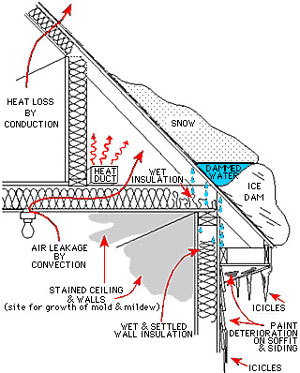
Figure-1

Image: UMN Extension

Looks like its time to re-post this: Last year, half the houses in the neighborhood developed ice dams. Part of the reason? This neighborhood has tons of bungalows.

The bungalow is native to sunny India, where the deep overhang of the eave acts like an awning.

Maine and India have little in common beyond the bungalow. Here, that overhang gets very cold, because it’s not heated by warm air rushing upward through the ceiling and into the attic.

That fleeing warm air does heat the roof over the attic, however, and melts the snow thereon. Water runs down the roof as god intended. But then it hits the unheated overhang and promptly freezes. Over time, a ridge of ice forms atop the eave. Now running water backs up behind a growing ridge of ice, seeps between the shingles, and enters parts of your house previously reserved for dryness.

The slanted ceiling of a bungalow’s second floor makes matters worse: You can’t add much insulation there to slow the flow of heat.

The outdoor angles compound the problem, as intersecting roof lines direct a lot of water toward the valleys.

What to do? Don’t do this: In a fit of freezing pique I once took a pickax to my ice dams. It tore that ice right up! And the roof under it, too!

Prevention, as usual, is the sensible thing. Maintain a clear path for water to take off the roof. Rake snow off the eaves before the cycle sets in.

And if you must build a bungalow in Maine, insulate the heck out of it.

MACHICOLATION: GEEK-REALTY WORD OF THE DAY

10854842_10152923464571670_7634129274494504696_o

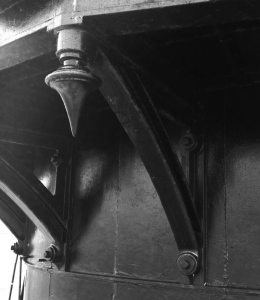
Photo: Jim Frederick; Spring Point Light

Machicolation: Architectural term meaning, literally, “neck smasher.” But it’s not what you think.

I actually don’t know what you think, when you picture an architectural item called a “neck smasher.” Here’s what I thought: My friend Jim Fredrick made this elegant photo of Spring Point Lighthouse. I wondered if the pendants on those brackets had a name. (They’re just “finials.”)

Then I wondered if those were eave brackets, or corbels. Which naturally led me to machicolations.

Back in the day–the Medieval day–crusaders of one persuasion or the other would sometimes chip at the base of your castle wall, or prance around down there shooting flaming arrows into your domicile. What to do?

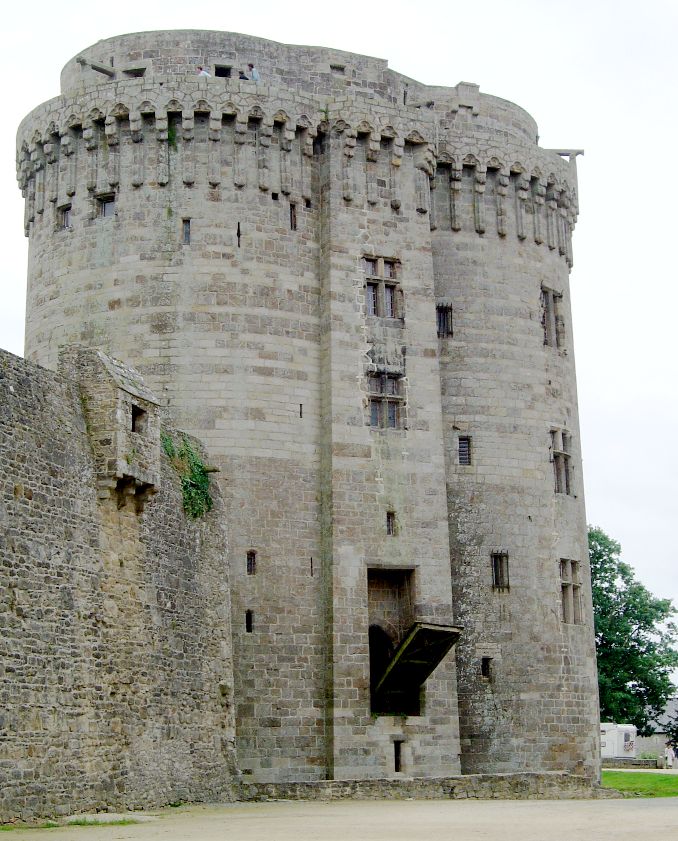
Architects of the day hence added a tier at the top of the wall, a tier which cantilevered out on supporting corbels like an upside-down wedding cake. They left holes in the floor of this new tier. Through these holes defenders could now drop great, big rocks onto the necks of the pests below. The Spanish called the holes matarcane, something like “for killing dogs,” aka infidels.

Machicolation galleries were lovely to look at, utility and terminology notwithstanding. Thus they have been carried forward into modern architecture–particularly military architecture, and lighthouses. Alas, most of them now lack the actual machicolations.

Chateau_Dinan1

Gallery machicolations atop tower; note “box machicolations” and/or latrine atop wall to left. [PD] Wikimedia